Director’s Cut: 2. AI shows the truth about your leadership
Director’s Cut is a no-fluff blog series. Mika Tarhala, Arter’s Managing Director, shares the reality of leadership. What he’s learned the hard way, where he’s succeeded, and why structures are everything.
AI doesn’t make your organisation smarter, it makes it faster. And speed without direction is a risk.
AI doesn’t make your organisation smarter. It makes what you do faster. And speed without direction is a risk that can scale into something massive — fast. In this blog, I’ll explain why your management system determines whether AI creates real competitive advantage or pure chaos. I’ll also share lessons from Arter’s own everyday work with AI.
Take the lessons from digitalisation with you
Do you remember the digitalisation push from ten years back?
The promise to revolutionise everything was partly kept. Work was digitised, processes sped up, and data started to accumulate. But a lot of waste was left along the way. Systems no one used. Processes that were moved into digital form exactly as they were. Change initiatives that failed because of leadership — not technology.
Now we’re at the same crossroads with AI. This time, we have a chance to do the change better.
AI exposes the cracks in leadership
Wondering why some organisations make a huge leap with AI while others stay stuck?
The answer is rarely in the technology. It’s in the systematics of leadership. Some organisations have thought through their leadership structures — they have a management system that runs the organisation. Others don’t.
A management system is the system through which your organisation leads itself every day. It isn’t just metrics and reports. It tells you how your organisation develops, learns, and renews itself. And how strategy turns into everyday action.
When your organisation’s leadership structures — your management system — are in place, AI acts as a catalyst that strengthens what already works. If the management system is missing, AI just adds speed in the wrong direction.
In practice, this shows up in three ways:
- If strategy is unclear, AI produces unclear content faster.
- If roles are blurred, AI automates the wrong things.
- If a shared situational picture is missing, the organisation moves faster — but in different directions.
4 tips for succeeding on the AI journey
1. Culture before technology — always
At Arter, we started our AI journey with one simple choice. We didn’t begin with tools or a project plan. We began with culture.
Our goal is to bring AI systematically into the use of the entire organisation and, at the same time, build solutions that deliver value to our clients.
It started with building an AI-positive culture. At Arter, we aim for a change in mindset — one experiment at a time:
How do I make my own everyday work easier with AI? From there, it’s a short step to: how do I make our clients’ everyday work easier with AI?
This is Arter’s mission in practice: Committed to ease your everyday life isn’t just a promise to our clients. It’s how we build our own operations as well.
In practice, we set a company-wide target for the number of experiments. Not for ROI. Not for quality. For sheer volume. We wanted to keep the threshold for experimenting as low as possible.
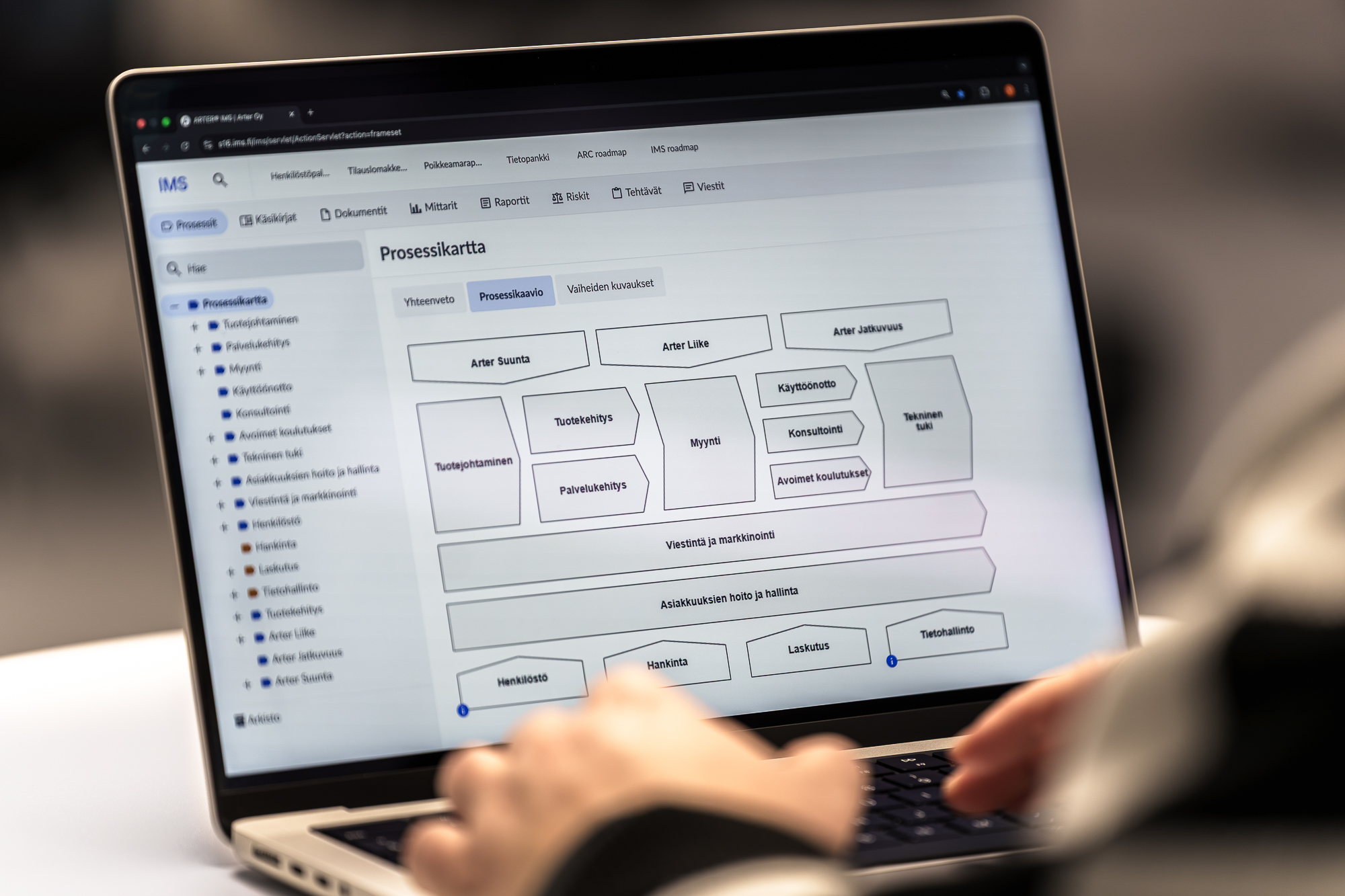
Experiments are logged briefly in our IMS software, results are shared in team weeklies and the company-wide monthly meeting, and successes are celebrated.
Our Q1 2026 results: 100 experiments, nearly 30 experimenters, and 92% reported gaining real value. In the final week of April, I personally logged 7 AI experiments.
Culture isn’t built through declarations. It’s built through leadership’s example.
2. Get the structures right — then bring in technology
Culture alone isn’t enough. It’s a necessary but not sufficient condition.
The second mistake in AI adoption is bringing in technology before the structures are ready to receive it.
Good leadership doesn’t mean only leading people. It means the ability to build the structures and processes in which obstacles to work become visible — and success becomes possible.
When leadership structures are missing, capable and committed people get overloaded. They carry the burden of unclarity on their own shoulders.
At worst, AI adds to the burden on individuals when the structures aren’t in place.
We saw this in practice at Arter in our product development:
Before bringing AI in, we first changed the development structures and methods to support it.
- We moved to pair coding to speed up peer learning.
- We adopted a test-driven development approach to strengthen human control over what AI produces.
- We invested in product management and product design. We continued deepening our customer understanding.
Why? Because AI produces code easily and in large amounts. The winners will be those who can steer the output in the right direction — agilely, failing fast, and learning through a validation loop.
3. Operations must be described before they can be improved
The third critical step is describing how the organisation actually works.
Do you know how the work is really done? Or does every process live slightly differently inside each person’s head?
When you know how things are done, you also know what’s worth developing — and what role AI should play in the bigger picture.
Without that foundation, AI investments are scattered randomly.
Describing operations forces the leader to think out loud:
- To make concrete what may have only existed inside the head.
- Once it’s written down, strategy can be turned into an action plan.
- The action plan creates a shared situational picture.
- The shared situational picture creates clarity about what gets done — and what’s expected of whom.
Only at this point does AI find its right role. That’s when AI is being led — instead of AI leading us astray.
4. Learning must be built into the system
The fourth step is making learning systematic.
AI capability doesn’t grow at the individual level — it grows at the organisational level. That requires learning to be built into everyday leadership, not left to occasional events.
At Arter, one person’s experiment is treated as everyone’s learning. This doesn’t happen on its own:
- It requires a structure that makes sharing information a natural part of everyday work.
- We log experiments lightly in the Reports section of our IMS software, and the reports are visible to everyone.
- Team weeklies are used to walk through experiments, and the best insights are highlighted in the company-wide monthly meeting.
- AI experiments are tied to the annual bonus, which scales with the number of experiments, not their quality. Money speaks the same language as leadership talk.
Leadership’s example matters here too. If the CEO or the director of business isn’t curious about AI’s possibilities, why would anyone else be?
A management system is a competitive advantage in the AI era
AI separates organisations that have a clear management system from those where leadership hasn’t been defined and structures haven’t been thought through.
Which group do you belong to? Threat or opportunity:
- Threat for those who bring AI in before the foundation is ready.
- Opportunity for those whose structures can carry the possibilities AI offers — to develop operations and change how the organisation works.
Smooth everyday work and renewing leadership emerge when leadership structures, practices, and systems form a clear and consistent whole.
When the foundation is in place, your organisation has what it takes to develop, renew itself, and succeed — also in the AI era.
Author of the Director’s Cut blog series: Mika Tarhala
Mika Tarhala is Managing Director at Arter Oy. With over 15 years of experience in the software and consulting industries, he has built a SaaS business from scratch to market leadership, leading it from Finland, with a distributed team, and for two years from Mexico. Today, he is building Arter as part of the European TSS group.
Mika’s leadership philosophy is captured in a single sentence:
Structure enables clarity, clarity builds trust, and trust drives growth.