5 myths about ARC – and why they’re wrong
Kirjoittaja:
Ella Lindroos
Arter’s ARC software, designed for enterprise architecture documentation, often sparks strong opinions and sometimes misunderstandings about its capabilities.
Is ARC just a lightweight EA tool?
Could Visio do the same job?
Is ARC too simple or on the contrary, too heavy for our organization?
In this blog, I’ll break down the most common misconceptions about ARC and explain why it is the right choice for your organization’s enterprise architecture work.
Myth 1: ARC is just a lightweight EA tool / ARC is not a real EA tool
These two claims often come from the same direction—architecture professionals looking for full ArchiMate support or deep analytics.
Those are valid requirements—for the right use case. But they are the wrong benchmark for ARC.
ARC combines architecture, processes, guidelines, and management into one whole. It doesn’t try to win in analytics. It aims to win in adoption—and in that game, theoretical correctness always loses to usability.
If architecture isn’t used, it doesn’t matter how correct it is.
Myth 2: ARC is just a process tool
This perception is reinforced by Arter’s strong reputation in process modeling.
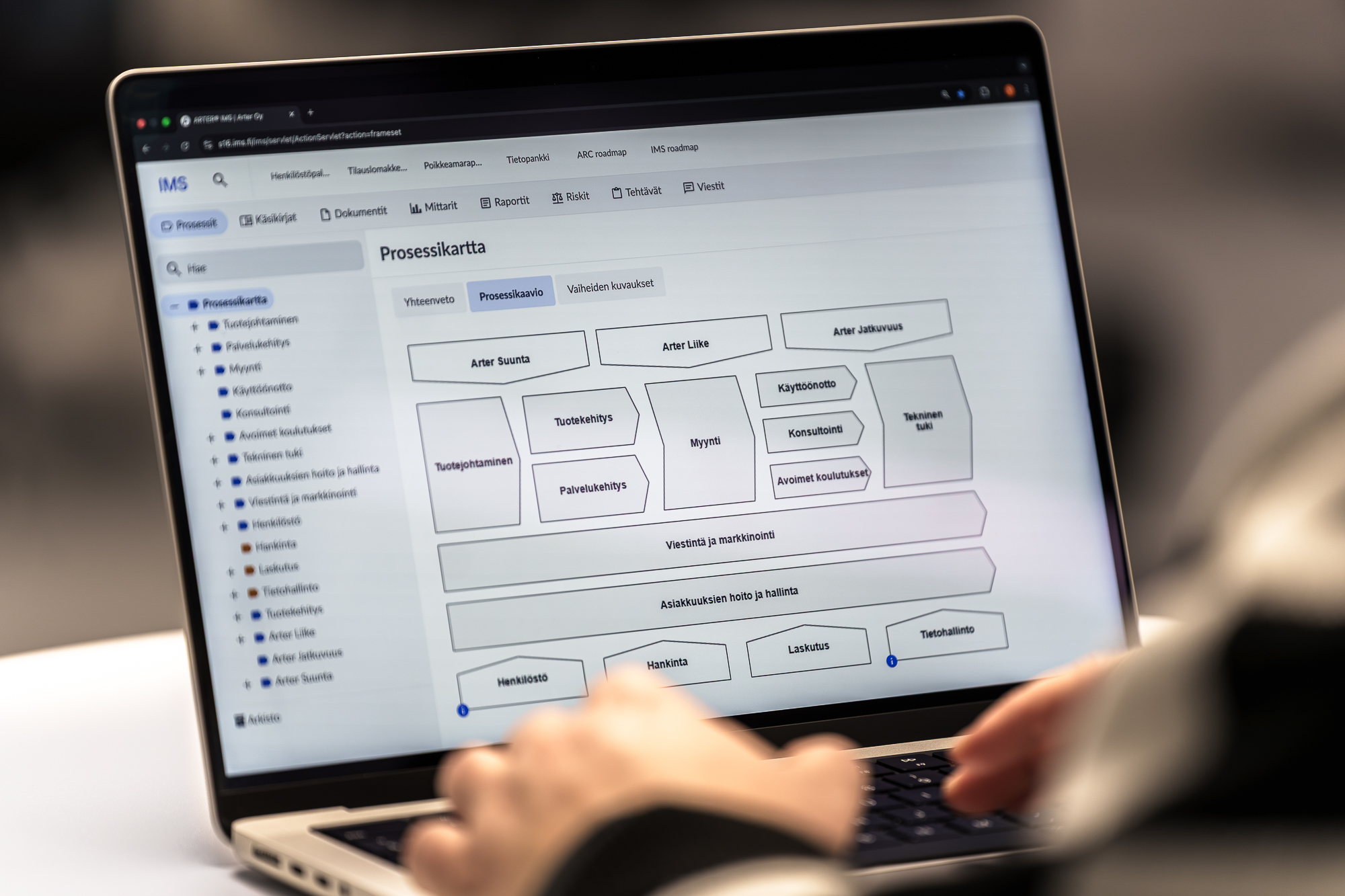
ARC does cover processes extensively. With the software, you can connect them to roles, responsibilities, strategy, and architecture. Operations are the layer where architecture either lives in everyday work—or gathers dust in a repository.
ARC is not a process tool with architecture added on top. It is an enterprise architecture platform where operations—your processes—are part of the foundation from the start.
Myth 3: ARC is not sufficient for demanding use
That depends on what you mean by “demanding.”
From a pure modeling perspective, other tools may go deeper—that’s true.
But in enterprise architecture initiatives, the hardest part is not modeling. It’s adoption and implementation. That’s exactly what ARC is designed for.
The real challenge is not what a tool can do—it’s whether it actually gets used.
Myth 4: ARC is only for the public sector
This is more a consequence than a feature.
The perception comes from ARC being widely used in the Finnish public sector.
But the need ARC addresses does not depend on industry.
As organizations grow and become more complex, a purely technical EA model is no longer enough. What’s needed is a holistic view where governance, processes, and architecture speak the same language.
The fact that the public sector adopted ARC early does not mean its benefits are limited to that sector.
Myth 5: ARC loses in comparison to modern EA tools
This is perhaps the most misleading claim of all.
- ARC = operations + management + architecture.
ARC doesn’t try to win in analytics. It aims to win in adoption and in enabling your organization to actually use enterprise architecture, both at the leadership level and among experts.
In enterprise architecture – regardless of the tool – one thing matters more than anything else: is it used or not?
The most sophisticated architecture model in the most advanced tool is useless if no one engages with it.
ARC is built on a simple premise:
Information is in one place, changes are reflected across the whole, and the big picture stays intact—even as the organization evolves.
This isn’t about what tool you use to draw diagrams. It’s about whether your information is alive and up to date.

Request ARC demo
Explore for free – no obligations, just insights
Want to explore ARC in more detail? Request a free demo below — we’ll be in touch shortly.